
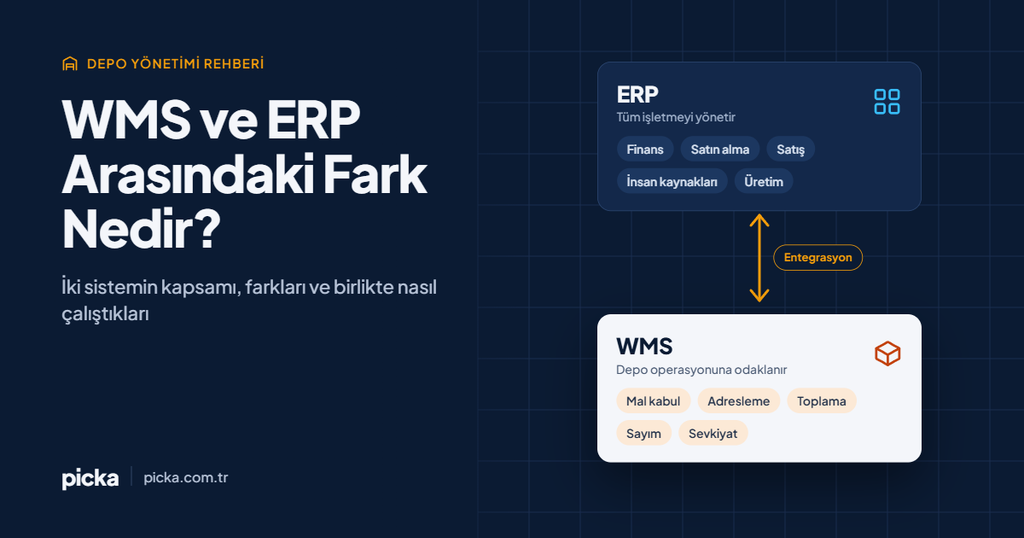
Businesses involved in warehouse and supply chain management frequently come across two acronyms during digital transformation: WMS (Warehouse Management System) and ERP (Enterprise Resource Planning). Both systems are used to manage business processes, but their scope, functions and focus are very different. In this article, we explain the difference between WMS and ERP under the main headings, which businesses need which system, and how the two systems can work together.
What Is ERP (Enterprise Resource Planning)?
ERP is the name of a comprehensive software system that brings together a company’s different departments, such as finance, accounting, human resources, purchasing, sales, production and inventory. Its goal is to collect company-wide data in a single place, eliminate data inconsistencies between departments and give senior management a holistic view.
For example, an ERP system shows and manages in a single structure how a sales order is reflected in financial records, how it affects production planning and how it is included in accounting reports. This is the first point to consider when trying to understand the difference between WMS and ERP: ERP is a strategic decision-support system that helps the business see the “big picture”.
What Is WMS (Warehouse Management System)?
A WMS works with a much more focused scope. It concentrates on managing in-warehouse operations and handles processes such as goods receipt, storage, order picking, packing and shipping in real time. The main goals of a WMS are to optimize physical movements inside the warehouse, reduce error rates and increase operational speed.
A company’s ERP system answers questions like “how much stock was sold and how much revenue was generated?”. A WMS explains operational details such as “where exactly is this product in the warehouse? Which employee picked which order, and how long did it take?”
Key Differences Between WMS and ERP
Scope and Focus
ERP covers all functional areas of the business, from accounting to human resources and from sales to production. A WMS, on the other hand, deals only with warehouse operations, offering narrow but in-depth functionality. The difference between WMS and ERP can therefore be summarized as follows: ERP represents the “general management” layer, while WMS represents the “operational execution” layer.
Level of Data Detail
ERP systems usually work with higher-level, summarized data. For example, they can show the total stock quantity of a product, but cannot know which shelf or aisle that stock is on in the warehouse. A WMS works with a much more granular data structure, tracking the exact location, lot number, expiry date and movement history of every product in real time. The level of data detail is the part of the WMS vs ERP difference that is felt most on the warehouse floor.
Real-Time Operation and Operational Speed
A WMS is built to manage physical movements inside the warehouse, so it is much better suited to real-time operation. Processes such as picking, packing and shipping are updated within seconds. ERP systems can also provide real-time data, but their focus is broader than instant operational movements.
User Profile
ERP systems are generally used by managers, finance teams and strategic decision makers. A WMS is used directly by warehouse floor staff, picking teams and logistics operators. The difference between WMS and ERP also shows in the user interface design of the two systems: WMS interfaces are usually compatible with handheld terminals and barcode scanners and designed for fast transactions.
Implementation Time and Cost
ERP implementation covers all departments of the business, so it generally takes longer and costs more. A WMS has a more focused scope, so it can be deployed relatively faster with a lower initial cost. Of course, this varies depending on the scale of the chosen solution and the needs of the business.
How Do WMS and ERP Work Together?
For many businesses, the question should not be “WMS or ERP?” but “how do we integrate WMS and ERP?”. The difference between WMS and ERP shows that the two systems do not replace each other — they complement each other.
In an integration scenario, the ERP system manages sales orders, purchase requests and financial data. This data is transferred to the WMS and turned into concrete operational tasks in the warehouse. For example, a sales order created in the ERP is sent to the WMS and broken down into picking, packing and shipping tasks. When the shipment is complete, the WMS reports the stock update back to the ERP system.
With this bidirectional data flow, the business gains full visibility at both the strategic and operational levels. While the ERP shows the big picture, the WMS captures what that picture looks like on the warehouse floor. In integration, the WMS vs ERP difference is not an obstacle but the basis of the division of labor.
Which Businesses Need Only a WMS, and Which Need an ERP?
For e-commerce businesses whose order volumes are growing and whose warehouse operations are becoming more complex, investing in a WMS is a priority, because their most urgent need is to maximize in-warehouse efficiency and reduce error rates.
For large businesses with multiple departments that want to manage their processes centrally, ERP is more comprehensive. Over time, these businesses also integrate a WMS module, either as an extension of the ERP or as a separate system.
Some ERP vendors add a basic warehouse management module to their systems, and this is where the difference between WMS and ERP becomes clear. These modules are often not detailed enough for intensive, complex warehouse operations. That is why businesses with high order volumes usually prefer a dedicated WMS solution and integrate it with their existing ERP system.
Questions to Ask Before Making the Right Decision
When deciding whether your business needs a WMS, an ERP or both, consider the following:
- What is our error rate in picking, packing and shipping, and how well are we managing time?
- Do we need to bring our financial, sales and production data together in a single central system?
- Are there data inconsistencies between our current systems?
- Is our growth rate making our current manual or semi-automated processes inadequate?
- Is our budget suited to a comprehensive ERP investment, or do we need a more focused WMS solution?
Answering these questions will help you identify your business’s priority needs.
In short, the difference between WMS and ERP is this: the two systems play different but complementary roles in business management. ERP is a strategic management approach covering the entire business, while a WMS manages day-to-day warehouse operations precisely and in real time. The size of your business, your industry and the complexity of your operations show which system you should prioritize.
In the long run, the most sustainable approach is to see these systems as complementary solutions and use them together with the right integration strategy. This turns the difference between WMS and ERP into an advantage, helping your business make better strategic decisions while achieving maximum efficiency in day-to-day warehouse operations.
Contact the Picka team to request a demo tailored to you. To read more articles, visit our blog.