
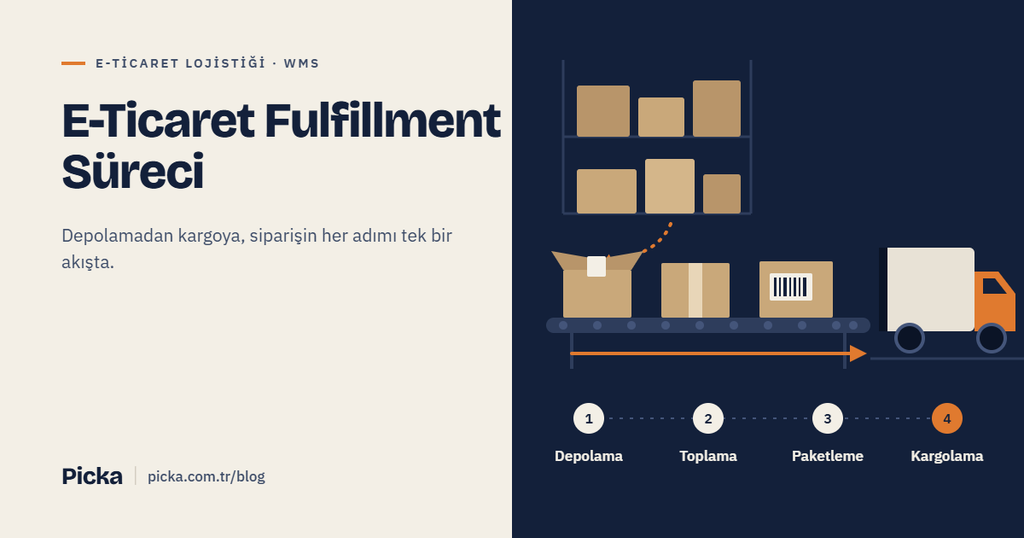
As e-commerce has grown, competition is no longer just about product and price. Customers judge how quickly, completely and smoothly they receive their order, and trust brands accordingly. The operation behind this experience is called fulfillment — the chain stretching from receiving the order to delivering the product to the customer and handling returns. When this process isn’t designed correctly, stock errors, delayed shipments and rising costs are inevitable.
In this article, we take a detailed look at the concept of fulfillment.
What Is Fulfillment?
Fulfillment (order fulfillment) covers all operational processes from the moment an order is created until it is delivered to the customer. It includes receiving products into the warehouse, putting them away on shelves and picking them when an order arrives. Packing, handing over to the carrier and, when needed, processing returns are also steps in this process.
Fulfillment isn’t just about “sending the product”. It is about delivering the right product, in the right quantity, to the right address, within the promised time and at the lowest possible cost. That is why it is critical for e-commerce, retail, manufacturing and 3PL companies.
How Does the Fulfillment Process Work, Step by Step?
A fulfillment operation consists of six interconnected core stages. An error at any step directly affects the next.
1. Receiving
Products from suppliers enter the warehouse. They are checked against the delivery note and go through quantity and quality control. A barcode or counting error at this stage corrupts stock accuracy from the very beginning.
2. Put-Away
Products are placed on suitable shelves and locations according to their turnover rate and characteristics. Placing fast-moving products close to the picking point saves significant time in later steps.
3. Inventory Management
The quantity, location, lot and expiry date of products in the warehouse are tracked in real time. In an operation without stock visibility, a product that has been sold may not actually be in the warehouse, and tying up capital in excess stock is a common mistake.
4. Order Picking
When an order comes in, products are taken from the shelves. Picking is the most labor-intensive and error-prone part of the fulfillment process. Different strategies such as discrete picking, batch picking and zone picking determine efficiency depending on order structure.
5. Packing
Products are checked, then packed in suitable packaging, and labels and shipping information are added. Choosing the right packaging reduces both damage rates and dimensional-weight shipping costs.
6. Shipping and Returns Management
Packages are handed over to the carrier, and tracking begins. Returned products are inspected and put back into sellable stock, or separated if they are not fit for sale. Known as reverse logistics, this step accounts for a significant share of costs, especially in textile and fashion categories.
Fulfillment Models
Businesses use different fulfillment models depending on their operational volume and resources.
In-house fulfillment: The warehouse, team and processes belong entirely to the business. Control is high, but fixed costs and operational burden also sit with the business. It works well for brands with predictable order volumes.
3PL fulfillment: Storage, picking, packing and shipping are outsourced to a third-party logistics provider. This offers flexibility for fast-growing brands or those with seasonal fluctuations, though control over the customer experience partly moves to an outside party.
Marketplace fulfillment: Products are stored in the marketplace’s warehouse and orders are fulfilled by the marketplace. Delivery speed is an advantage, while commissions and service fees increase costs.
Dropshipping: No stock is held; orders are shipped directly from the supplier to the customer. There is no inventory cost, but control over delivery time and product quality is at its lowest.
Are Fulfillment and Shipping the Same Thing?
Fulfillment and shipping are often confused. Shipping is only the last link in the fulfillment process — the transport of the package. Fulfillment covers the entire chain from receiving to returns. A business may work with the fastest carrier, but if picking and packing inside the warehouse are slow, delivery performance will still be poor.
The Role of a WMS in Fulfillment
Once order volume passes a certain level, fulfillment can no longer be managed with Excel spreadsheets and manual work. This is where a WMS — a warehouse management system — comes in.
A WMS contributes to the fulfillment operation in the following ways:
- Real-time stock visibility: You can see in real time how much of each product you have and in which location.
- Optimized picking routes: The system determines the shortest picking route in the warehouse, reducing staff walking distance.
- Barcode and mobile terminal support: Scanning at every step largely prevents wrong shipments.
- Lot and serial number tracking: Supports traceability, especially for food, cosmetics and medical products.
- Integration: Data flows automatically with e-commerce platforms, ERP systems and carriers.
- Reporting: Every metric, from picking speed to error rate, becomes measurable.
If the warehouse operation is managed together with shipping and distribution, the WMS can work integrated with a TMS (Transportation Management System), making the process controllable end to end.
Which Metrics Measure Fulfillment Performance?
You can’t improve what you don’t measure. The key indicators to track when evaluating fulfillment performance are:
- Order accuracy rate: The ratio of error-free orders to total orders.
- Order fulfillment time: The time from when an order arrives until it is handed to the carrier.
- On-time delivery rate: The percentage of orders delivered on the promised date.
- Inventory accuracy rate: How closely stock data in the system matches the physical count.
- Cost per order: Picking, packing, packaging and shipping costs divided by the number of orders.
- Return rate and return processing time: The burden of reverse logistics on the operation.
Frequently Asked Questions
What is a fulfillment center? It is an operations center where products are stored and orders are picked, packed and prepared for shipping. Unlike a classic warehouse, it is designed for fast order fulfillment rather than long-term storage.
Does a small e-commerce business need a fulfillment system? When daily order volume is low, manual tracking is enough. But as product variety and order volume grow, stock errors and delays grow quickly. Moving to a systematic structure costs less when it’s done before problems become chronic.
How can fulfillment costs be reduced? Organizing the warehouse layout by product turnover and optimizing picking routes lower costs. Choosing the right packaging and reducing the error rate also cut costs directly.
Fulfillment determines customer satisfaction in e-commerce and logistics operations. A well-designed order fulfillment process reduces stock losses, shortens delivery times and keeps operating costs under control. The foundation of this control is the traceability and measurability of every movement in the warehouse.
With Picka WMS — or Picka One for e-commerce fulfillment — you can manage your warehouse operations end to end, increase stock accuracy and speed up order fulfillment.
Contact the Picka team to request a demo tailored to you. To read more articles, visit our blog.